
What is a
Concussion?
A Concussion is a form of a Head Injury.
A concussion is a common form of head injury, often categorized as a mild traumatic brain injury (MTBI). It is an injury that results from a direct or indirect blow to the head, face, or jaw causing an alteration of brain functions evident through a variety of related symptoms.
Damage to the brain during a concussion results from the sudden shifting of the brain inside the skull. This shifting can cause the brain to knock against the hard bone of the skull, causing the nerve fibers within your brain to shear and stretch.
In about 90% of sport-related concussions, there is no unconsciousness; cranial CT or classic MRI usually do not show any abnormalities. A concussion is often not recognized as such by athletes or coaches because it manifests itself in rather unspecific symptoms. Some typical complaints or symptoms are headaches, neck pain, nausea, vomiting, and dizziness. More signs and symptoms can be found on our Signs and Symptoms page.
The symptoms associated with a concussion usually subside within one to two weeks after the injury. In the first 24 to 48 hours after a concussion, however, there is an increased risk of intracranial complications such as cerebral hemorrhage. In addition to a general increase in the probability of injury, after a concussion, the risk of suffering another – possibly more serious – head injury increases three to six times.
The brain is in what is known as a “vulnerable phase”, in which it is more susceptible to further damage. Various pathophysiological processes are discussed as possible causes for this. Since athletes often report a slowdown in the rate of reaction and the parallel processing of information after a slight traumatic head injury, the athletes concerned also run the risk of performing poorly or making mistakes that are decisive for the game due to the limitations of this attention components.
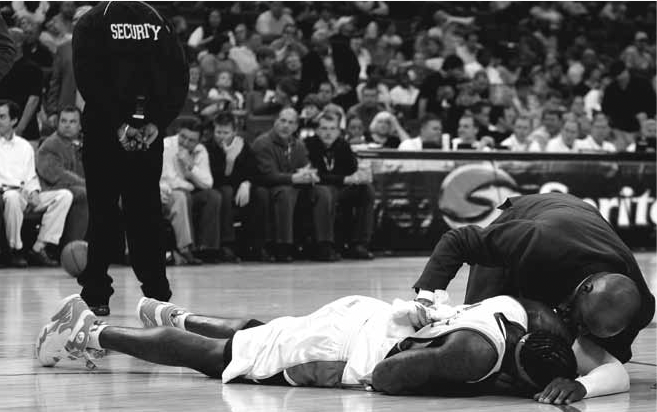
Gerald Wallace of the Charlotte Bobcats suffers a concussion from a hit to the face by Mikki Moore of the Sacramento Kings (February 22, 2008).
If an athlete suffers multiple concussions in the course of their career, their effects can accumulate over time. There is a risk of chronic impairments with negative effects on further athletic careers and private lives. If the symptoms do not subside within a period of three months, one speaks of a so-called “post-commotional syndrome”. This syndrome occurs in about 10% of all people who have had a concussion. A rare but extremely serious complication is the so-called “Second Impact Syndrome”.
If another brain trauma occurs in the vulnerable phase after a concussion, this can lead to a life-threatening disruption of cerebrovascular autoregulatory processes. Unfortunately, this has also resulted in deaths in American football, ice hockey, and soccer. Recently, the development of chronic traumatic encephalopathy (CTE) has been discussed as a possible long-term consequence of repetitive mild brain trauma. Dr. Stanwell & Prof. Gardner reports.
What Happens to the Brain In a Concussion
A direct or indirect blow to the head, face or jaw can cause the brain to accelerate, and then rapidly decelerate within the skull. This acceleration/deceleration motion can induce mechanical changes to the nerve fibers within the brain, and in turn, alter several important metabolic pathways. Though injury is apparent given the spectrum of symptoms experienced by a concussed athlete, no structural damage is caused to the brain itself. That is, unlike with other sports injuries (like a fractured wrist or a dislocated shoulder) nothing is visibly “wrong” or abnormal on standard imaging studies such as X-rays, computed tomography (CT) or medical resonance imaging (MRI).
This “invisibility” is part of the reason why concussive injuries have historically been largely overlooked and mismanaged by the medical system. We understand now that just because we can’t see the injury, doesn’t mean an injury hasn’t been sustained.
A concussion, in simple terms, changes the way the brain functions. In most cases, this change is temporary and reversible. Sometimes, however, changes in physical, cognitive, emotional and behavioral functions are long lasting and devastating. Researchers are only now beginning to understand the impact this injury has on the brain and the way it works.
Current evidence suggests that the rapid stretch of nerve fibers within the brain during a concussive trauma results in the release of various neurotransmitters (signaling molecules within the brain), which trigger the initiation of a complex neurochemical and neurometabolic pathway.
Ultimately, the brain starts to consume energy more quickly than it can replenish it, creating a generalized depression in brain metabolism. These changes take place within minutes of the injury and can last for hours or days before normalization occurs. This metabolic imbalance, along with other impaired physiological processes, is thought to contribute to the physical, cognitive, behavioral and emotional signs/symptoms typically seen in a concussed individual.
Additionally, when the brain is in this state of metabolic dysfunction, it is believed to be more vulnerable to subsequent trauma. That is, a relatively minor second blow to the head may produce more severe and irreversible changes in brain function. The physiologically altered brain is essentially weakened and less able to withstand or recover from a subsequent concussion. In this way, concussive injuries are thought to be cumulative, with progressively less force required to induce trauma to the brain each time (when occurring in close temporal relation).
What’s more, the symptoms experienced may be completely disproportionate to the mechanism of injury. What would have been two “mild” head injuries summate to form a more severe traumatic brain injury with longer-lasting impairment.
What to do in case of uncertainty
If you are not sure or think you have a concussion, then it is essential that you talk to someone about it! Even if you yourself may think that it is not that bad, you will still get a more objective opinion of your physical and mental state from important people around you.
Even with the slightest uncertainty about your condition, there is only one way to go: see a person with the appropriate medical training, preferably a neurologist. Here you will receive the specialist advice you need to deal with your injury accordingly.
Only a doctor will be able to explain the severity of your injury and guide you through the treatment steps necessary to give your brain the rest it needs to recover.
With a correct diagnosis and correct treatment, one can recover from a concussion relatively quickly and without permanent damage. Typically, a concussion requires a great deal of rest and a significant reduction in your physical exertion.
Even if it is difficult, activities such as driving a car, watching TV, reading, video games or physical exertion must be completely stopped. Failure to do so means that the healing process will take significantly longer. Undiagnosed or untreated concussions can have devastating effects on your life in old age.
Get Involved
Whether you want to make a donation or get involved with our team, your help is always appreciated!
Donations are used towards funding educational material for coaches, parents, and teachers and allow us to continue our work in general. If you want to work with us or become an ambassador to help spread the word, please don’t hesitate to contact us! If you are interested, click one of the buttons on the right.
About Us
StopConcussions is a non-profit company, that aims to bring players, parents, coaches and officials information on brain concussions and their consequences in contact sports.
This website is here to help educate and are not intended to replace medical care and/or professional supervision. There is no substitute for a competent neurologist, physician, health professional or clinician when it comes to diagnosing and managing concussions. What StopConcussions offers is an insight into the nature of a brain injury. It is a guide to help you understand the cause, effects and consequences of concussions as well as how you can help reduce the incidences of the injury, manage the injury better and be able to ask all the right questions when dealing with a concussed individual.
The brain is complex, and each injury is personalized. Not only is every brain different, so is every concussion, and the therapy must be tailored to each individual. With this said, only a physician or qualified healthcare professional who has been educated in concussions can recommend a treatment and rehabilitation program. If you have any questions or concerns regarding a specific injury, contact your physician immediately.
Contact Us
Whether you need help dealing with a concussion, need information or other materials or are a concerned parent or coach, we are happy to help. Please contact us with any and all inquiries regarding our field.